Blog · Learning AI
Best AI Newsletters to Follow in 2026-27: 10 Worth Reading
Subscribe to five AI newsletters and you will soon have fifty unread emails a week saying the same thing. The useful approach is to pick one quick daily brief and one deeper weekly read that match your job. This list covers ten newsletters that were publishing in October 2026, what each one is like to read, how often it arrives and who it suits, plus where Claude users can get news straight from Anthropic.
AI news moves faster than anyone can follow. New models, new features and new companies arrive every week, and most of it does not change how you work. A good newsletter does the filtering for you. A poor one adds to the noise.
We built this list by opening each newsletter’s own website and archive or feed in October 2026, checking that recent issues were going out, and reading them for style, depth and audience. Reader numbers appear only where the publisher shows them on its own page, and they are the publisher’s figures, not ours. This is a shortlist, not a ranking, and no publisher paid or asked to be included.
Quick answer: ten AI newsletters worth reading
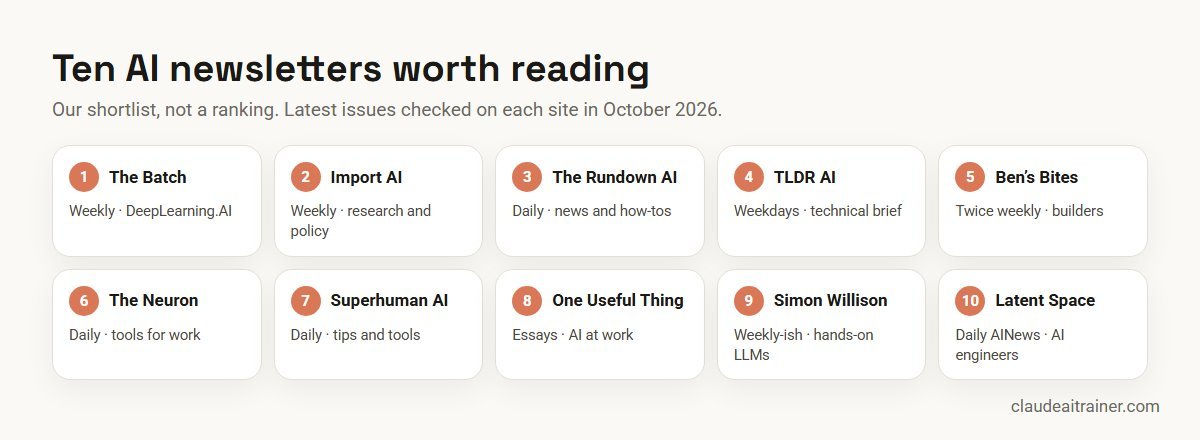
- The Batch (weekly): AI news and analysis from DeepLearning.AI.
- Import AI (weekly): research and policy, written by Anthropic co-founder Jack Clark.
- The Rundown AI (daily): short news plus practical how-to guides.
- TLDR AI (every weekday): a technical brief on models, papers and tools.
- Ben’s Bites (twice a week): vetted launches and build videos for AI builders.
- The Neuron (daily): news and tools for professionals, in plain language.
- Superhuman AI (daily): quick news, tools and tutorials for work.
- One Useful Thing (essays): what AI means for work and education, by Ethan Mollick.
- Simon Willison’s Newsletter (about weekly): hands-on notes on LLMs and coding tools.
- Latent Space (daily AINews plus essays): for AI engineers.
Looking for the best AI newsletters for beginners? Start with The Rundown AI, The Neuron or Superhuman AI. Prefer AI newsletters on Substack? Import AI, Ben’s Bites, One Useful Thing and Simon Willison’s Newsletter are all published there.
Comparison table
| Newsletter | Cadence | Style | Best for | Platform |
|---|---|---|---|---|
| The Batch | Weekly | News with analysis | Anyone wanting one solid read | DeepLearning.AI site |
| Import AI | Weekly (Mondays) | Research and policy | Leaders, researchers | Substack and blog |
| The Rundown AI | Daily | News plus how-tos | Beginners, professionals | Own site |
| TLDR AI | Every weekday | Short technical summaries | Engineers, product teams | Own site |
| Ben’s Bites | Tuesday and Thursday | Launches, build videos | Builders, founders | Substack |
| The Neuron | Daily | Plain-language news, tools | Non-technical professionals | Own site |
| Superhuman AI | Daily | Quick tips and tools | Busy professionals | Own site |
| One Useful Thing | Every few weeks | Long essays | Managers, educators | Substack |
| Simon Willison | About weekly | Hands-on notes | Developers, power users | Substack |
| Latent Space | Daily AINews plus essays | Deep technical | AI engineers | Own site |
The ten newsletters in detail
1. The Batch (DeepLearning.AI)
What it is. DeepLearning.AI’s weekly newsletter of AI news and insights. It covers a handful of developments each week with more explanation than a headline digest. Issue 376 went out on 23 October 2026. Cadence: weekly. Who it suits: anyone who wants a single, balanced weekly read that explains the significance of news rather than just listing it. The Batch.
2. Import AI
What it is. A weekly newsletter of detailed analysis of AI research, written by Jack Clark, who describes himself on its About page as a co-founder of Anthropic. Issues mix research summaries and policy, and usually end with a short piece of fiction called Tech Tales. Issue 477 went out on 19 October 2026. Cadence: weekly, usually Mondays. Who it suits: leaders, policy people and researchers who want to know where AI capability is heading. For Claude users it is a view from inside one of the labs, though it is a personal newsletter, not Anthropic product news. Import AI.
3. The Rundown AI
What it is. A daily newsletter that promises the latest AI news, why it matters and how to apply it at work, in about five minutes. The site also publishes daily implementation guides, a tools directory and a podcast hosted by founder Rowan Cheung. Cadence: daily. Who it suits: professionals and beginners who want news with a practical “try this” angle. The Rundown AI.
4. TLDR AI
What it is. A free newsletter sent every weekday that summarises model releases, research papers and new tools in a few sentences each, with links to the source. Its page shows 1,100,000 subscribers (as shown on tldr.tech, checked October 2026). Cadence: every weekday. Who it suits: engineers, researchers and technical product people who want coverage without commentary. TLDR AI.
5. Ben's Bites
What it is. Its About page describes a Tuesday and Thursday summary of news and new launches, vetted by the team, plus videos on how to build with AI tools. Recent issues covered Claude’s personal agent and prompt tips from Anthropic. Cadence: twice a week. Who it suits: founders, builders and anyone who wants to try new tools rather than just read about them. Published on Substack. Ben’s Bites.
6. The Neuron
What it is. A daily newsletter of AI trends and tools written in plain, often playful language, with occasional deep dives. Its homepage says 700,000+ professionals read it (as shown on theneurondaily.com, checked October 2026). Cadence: daily, with issues on most days we checked. Who it suits: non-technical professionals and managers. The Neuron.
7. Superhuman AI
What it is. A short daily edition of AI news, tools, prompts and tutorials aimed at using AI at work, billed as a three-minute read, plus a Sunday special. Issues are signed by Zain Kahn and the team. Cadence: daily. Who it suits: busy professionals who want one practical tip a day. Superhuman AI.
For teams
Reading about AI is the easy part
Newsletters tell your team what changed. Hands-on practice shows them what to do with it. We run short, practical sessions where people use Claude on their own documents and workflows. Book a short call if that would help.
8. One Useful Thing
What it is. A research-based view on what AI means for work, education and life, by Ethan Mollick, a professor at Wharton and author of Co-Intelligence. He notes that he writes every post himself. Posts are long and often built around his own experiments with AI tools. Cadence: every few weeks; the latest when we checked was on 20 October 2026. Who it suits: managers, educators and anyone deciding how their team should use AI. Published on Substack. One Useful Thing.
9. Simon Willison's Newsletter
What it is. A digest of Simon Willison’s blog on LLMs, web engineering, open source, Datasette, SQLite and Python. He tests new models and coding tools hands-on and writes up what works, what breaks and the security risks, including prompt injection. Claude, ChatGPT and Gemini releases all get detailed coverage. Cadence: about weekly. Who it suits: developers and power users who want first-hand testing rather than press releases. Published on Substack. Simon Willison’s Newsletter.
10. Latent Space
What it is. Started in 2022 by swyx to make sense of the emerging AI engineering field. Today it publishes daily AINews briefings, long essays and a podcast, plus community events. Cadence: AINews most days, essays and podcasts several times a week. Who it suits: AI engineers and technical leaders. It is dense, so it is not a beginner’s first newsletter. Latent Space.
Also worth a look
- Interconnects: Nathan Lambert, a research scientist at the Allen Institute for AI (Ai2), on open models and post-training. Substack.
- Exponential View: Azeem Azhar’s weekly analysis of technology, business and society. Its About page says over 100,000 investors, founders, policy-makers, academics and analysts read it (as shown on exponentialview.co, checked October 2026). Substack.
- Last Week in AI: weekly text and audio summaries of AI news, run by Andrey Kurenkov. Substack.
- AlphaSignal: a technical summary of new models, repositories and papers for engineers.
For Claude users: news straight from Anthropic
General newsletters cover Claude alongside everything else, sometimes days late. If your team uses Claude every day, add two first-party sources:
- Anthropic’s newsroom: model launches, product announcements and policy updates, posted as they happen.
- The Claude developer newsletter: a monthly email from Anthropic. The sign-up form is on claude.com.
Pair them with Import AI for research context and Simon Willison for independent hands-on testing. When a new feature lands, our guides on Claude skills, plugins and connectors and the best Claude plan for business help you decide whether it matters for your team.
What makes an AI newsletter worth your time
Before you subscribe to anything, including the ten above, check an issue against four tests:
- Sources are linked. Every claim should point to the paper, announcement or product page it came from, so you can check it.
- It separates news from opinion. Good writers say clearly when they are speculating.
- Sponsored items are labelled. Most free newsletters carry ads. They should look like ads.
- It tells you what to do. The most useful issues end with something to try, read or watch for, not just a list of headlines.
Sample reading plans by role
- Manager or team lead. The Neuron or The Rundown AI on weekdays, One Useful Thing when a new essay arrives, and Anthropic’s newsroom if your team uses Claude. About 30 minutes a week.
- Marketer or operations specialist. Superhuman AI for daily tips and Ben’s Bites twice a week for new tools to try. Test one tool a week on a real task.
- Developer. TLDR AI on weekdays, Simon Willison weekly and Latent Space for depth. Add the Claude developer newsletter if you build on Claude.
- Founder or senior leader. The Batch and Import AI on the weekend for context, plus Exponential View for strategy and policy.
- Student. The Batch weekly, plus one daily brief. Spend the time you save on building something small.
How to choose the right newsletters
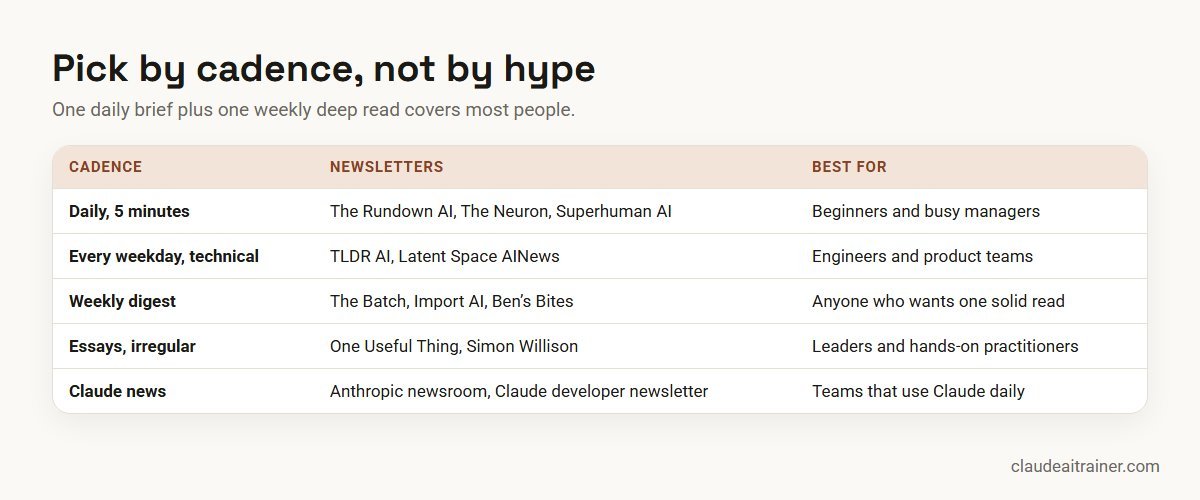
- Pick a cadence you will keep. If you will not read a daily email, choose a weekly one. Unread newsletters teach nothing.
- One daily, one weekly. A short daily brief keeps you current; a weekly read gives you context. That pairing covers most people.
- Match the depth to your role. Managers and non-technical staff get more from The Neuron, The Rundown AI or One Useful Thing. Engineers get more from TLDR AI, Latent Space and Simon Willison.
- Read two issues before deciding. Every archive is public. Check whether the writing is clear, sourced and useful to you.
- Watch for sponsored items. Most free newsletters carry sponsors. That is normal, but treat a sponsored tool mention as an ad, not a review.
- Prune monthly. If you have not opened a newsletter in a month, unsubscribe.
Newsletters versus other ways to keep up
Newsletters are not the only option, and they are not always the best one.
- Official changelogs and newsrooms are the most accurate source for a tool you already use. If your team works in Claude, Anthropic’s newsroom will tell you about a launch before most newsletters do.
- Podcasts suit commuters. Several newsletters on this list, including The Rundown AI and Latent Space, also run podcasts.
- YouTube is better for seeing a tool in action. Our list of AI YouTube channels in India covers channels in Hindi and English.
- Hands-on practice is the only way to turn any of it into skill. A newsletter can tell you a feature exists; using it on your own work tells you whether it helps.
A reading routine for teams
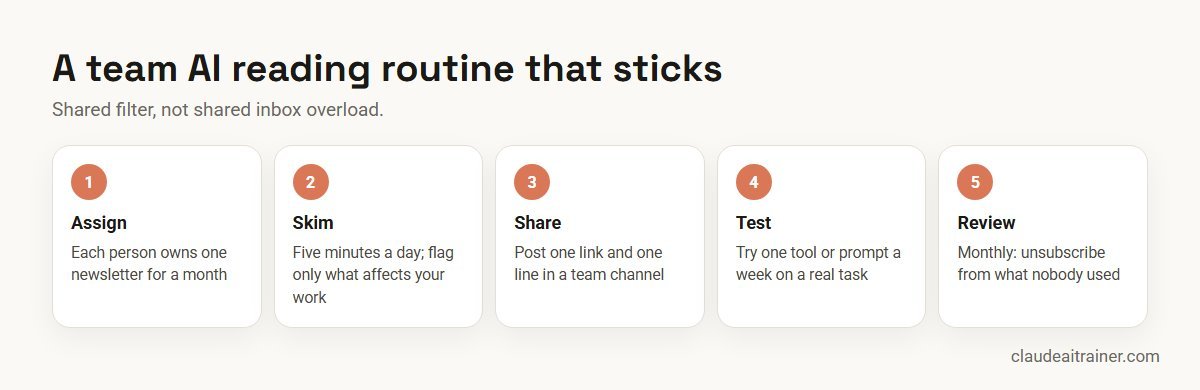
When a whole team subscribes to the same five newsletters, everyone reads the same headline and nobody acts on it. A shared routine works better:
- Assign. Each person owns one newsletter for a month and reads it closely.
- Skim. Five minutes a day; flag only items that affect your team’s work.
- Share. Post one link and one line on why it matters in a team channel. One link a week per person is plenty.
- Test. Once a week, try one tool, feature or prompt on a real task, using tools your company has approved.
- Review. Monthly, keep what produced useful ideas and drop the rest.
The step most teams skip is the test. Reading that Claude can now work across Excel and PowerPoint is not the same as building your monthly report with it. If your team needs that practice, corporate Claude AI training runs on your own files, and individuals can join an open batch. Prefer video? See our list of the best AI YouTube channels in India.
Next step
From inbox to everyday workflow
We help teams turn the ideas they read about into tested prompts, shared skills and simple house rules, built on their own files. Online or on-site.
How we checked this list
- We opened each newsletter’s own website, archive or feed on 26 October 2026 and confirmed recent issues.
- We describe cadence from the publication dates of recent issues and the publisher’s own description.
- Reader figures appear only where the publisher shows them on its page, labelled as such. We left them out where a site showed conflicting figures.
- No newsletter paid to be included, and we did not list any newsletter run by our own trainers.
Key takeaways
- One daily brief plus one weekly deep read covers most people's needs
- Beginners do well with The Rundown AI, The Neuron or Superhuman AI; engineers with TLDR AI or Latent Space
- The Batch, Import AI and Ben's Bites are solid weekly reads
- One Useful Thing and Simon Willison are the pick for thoughtful, hands-on essays
- Claude users should add Anthropic's newsroom and the monthly Claude developer newsletter
- Unsubscribe from anything you have not opened in a month
FAQ
AI newsletters: common questions
What are the best AI newsletters to subscribe to?
Our shortlist for 2026-27 is The Batch, Import AI, The Rundown AI, TLDR AI, Ben’s Bites, The Neuron, Superhuman AI, One Useful Thing, Simon Willison’s Newsletter and Latent Space. Most people do well with one daily brief and one weekly read.
What are the best AI newsletters for beginners?
The Rundown AI, The Neuron and Superhuman AI are written for non-specialists and take a few minutes a day. The Batch is a good weekly choice once you want more context.
Which AI newsletters are on Substack?
Import AI, Ben’s Bites, One Useful Thing and Simon Willison’s Newsletter are published on Substack, as are Interconnects, Exponential View and Last Week in AI.
Are these AI newsletters free?
All ten have a free way to read or subscribe. Some publishers also offer paid tiers or courses, which are optional.
Which AI newsletter is best for developers?
TLDR AI for a quick weekday technical brief, Latent Space for AI engineering depth, and Simon Willison’s Newsletter for hands-on testing of models and coding tools.
Which AI newsletter suits managers and business leaders?
One Useful Thing is written for people deciding how to use AI at work. The Neuron and The Rundown AI keep managers current in a few minutes a day.
Does Anthropic have a newsletter?
Anthropic offers a monthly Claude developer newsletter with sign-up on claude.com, and posts announcements on its newsroom at anthropic.com/news. Import AI is written by Anthropic co-founder Jack Clark, but it is his personal newsletter.
How many AI newsletters should I follow?
Two is enough for most people: one daily brief and one weekly read. Add a third only if it serves a specific need, such as research or a tool you use every day.
What do people on Reddit recommend?
Recommendations vary by community and change often. Whatever a thread suggests, read two recent issues in the newsletter’s public archive before you subscribe.
Why do some entries show reader numbers and others do not?
We only show figures that the publisher displays on its own page, labelled with the source. Where a site showed no figure, or conflicting ones, we left it out.
Is there an Indian AI newsletter on this list?
This list focuses on widely read newsletters that cover AI globally. For Indian creators teaching AI, including in Hindi, see our list of AI YouTube channels in India.
How can my team actually use what it reads?
Use a simple routine: each person owns one newsletter, shares one useful item a week, and the team tests one idea on real work. Hands-on training on your own files speeds this up.
Trusted by
Teams we’ve trained
…and 200+ organisations, across 16+ countries.
What participants say
Real feedback from real sessions
Verified feedback collected from participants across corporate sessions — average rating 4.8/5.
“A very productive session for working professionals. A must-do.”
“The session was highly insightful and conducted in a very professional and interactive manner. Learnt about AI and excited to learn more!”
“Highly recommended! Hands-on and directly useful — from making PPTs and strategic plans to building KRAs.”
“I would recommend everyone to go through this session — it clarifies both what to expect from AI and where AI isn’t needed.”
“A nice interactive session with a lot of new insights and the power of AI. This will help me save time in routine activities.”
“A very good training session. AI can do wonders — we’ll implement it to create efficiency and save time.”
Explore more
Keep going with Claude AI training
Work with us
Help your team use what it reads about
Tell us about your team and the work you want AI to help with. We will suggest a short, hands-on format, online or on-site (for example Claude AI training in Mumbai or Pune), and send a fixed proposal, usually within one business day.